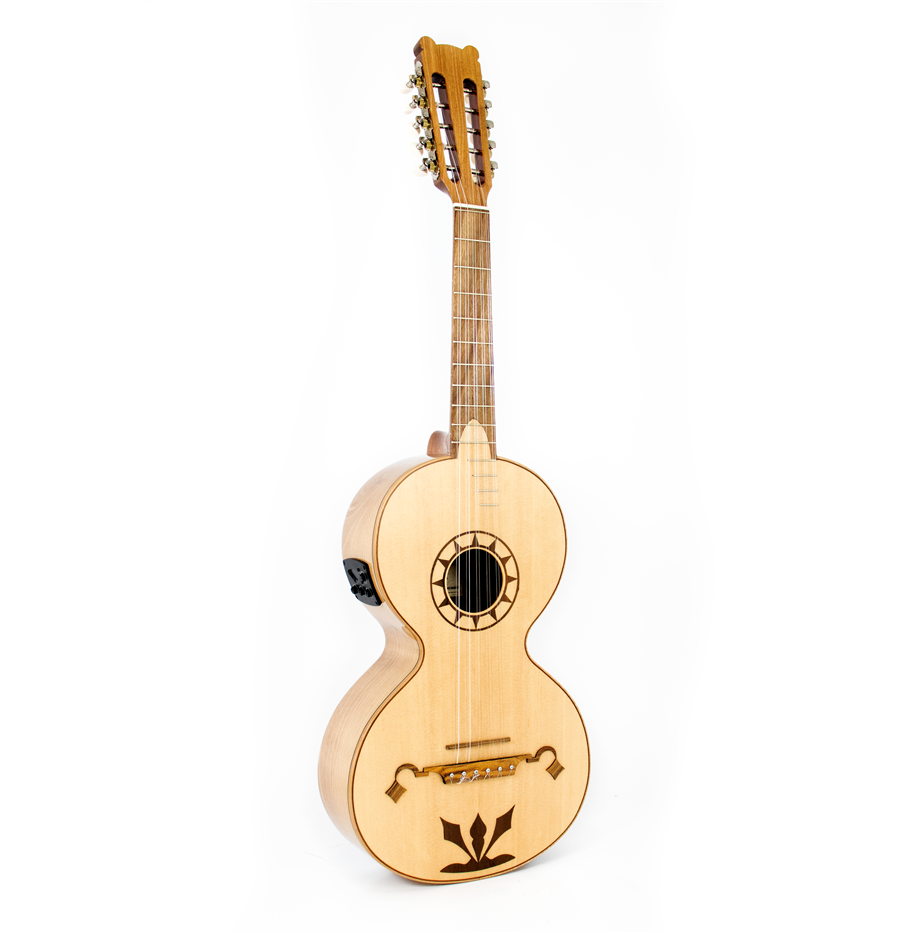
The Artimúsica VA40S viola campaniça brings the spirit of the improvised songs of the Alentejo plains.
The musical tradition of Alentejo is rich and intense. The viola campaniça, also known as the viola alentejana, is a beautiful and sometimes forgotten stringed instrument of Portuguese folk tradition. With its bright and melodious sound, this instrument from the family of wire-stringed guitars served as accompaniment to improvised songs or at traditional festivals and fairs in Alentejo.
Artimúsica, with all its experience and expertise in building traditional Portuguese stringed instruments, has created a viola campaniça that respects the spirit and tradition of the people of Alentejo. The Artimúsica VA40S is a simple model with a round soundhole and a solid spruce top. The back and sides are made of walnut, and the neck is mahogany with a panga panga fingerboard.
The viola campaniça is a large instrument, compared to other Portuguese stringed instruments, measuring approximately 110 cm in length, with a slender, figure-eight shaped soundbox that is very tightly packed. It is normally played only with the thumb, and served as accompaniment to the improvised songs of men who took refuge in taverns, sheltered from the sun and the hard work of the plains, as well as to the country tunes played at dances, fairs, and pilgrimages in the region.
Like other Portuguese stringed instruments, it has five courses of strings, with the three highest courses being double courses tuned in unison, and the two lowest courses tuned in octaves.
The tuning is B3 – G3 – E3 – A2 – E2 (the last two positions are an octave higher).